Performed by Dr. Surya Sri Krishna Gour
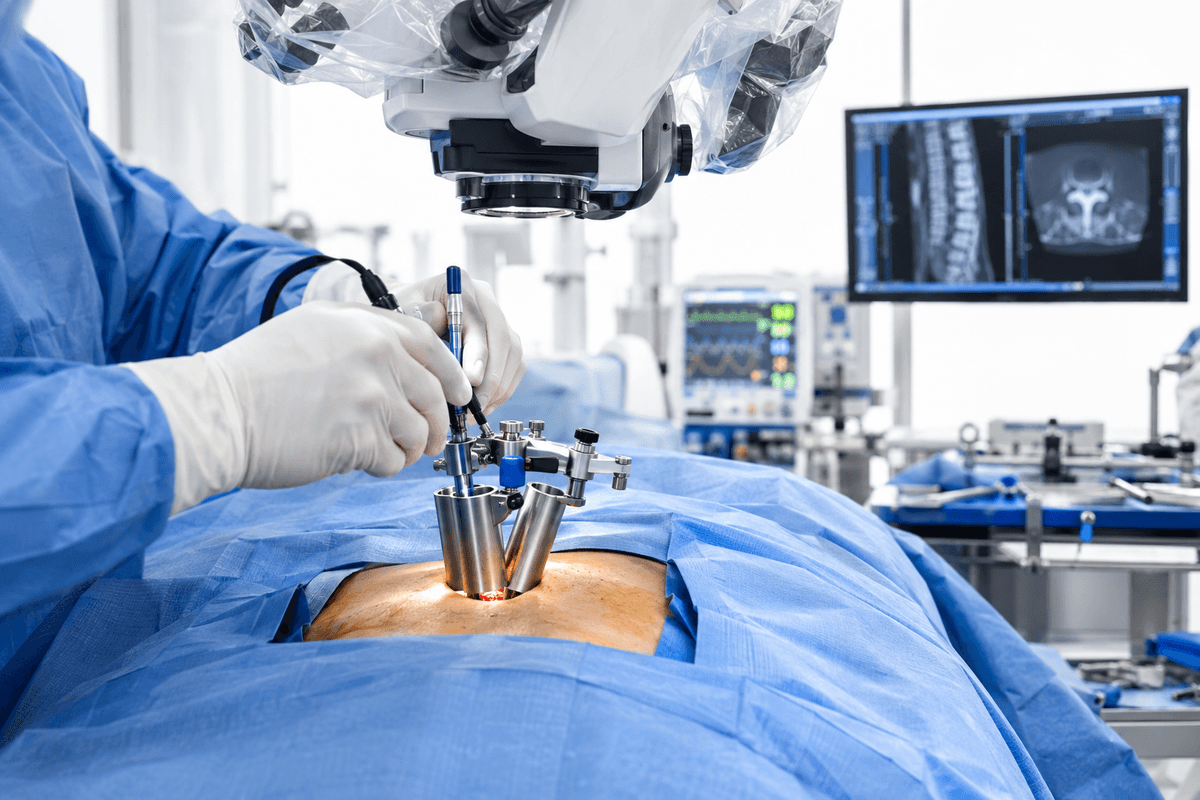
Minimally invasive spine surgery is a group of techniques that allow surgeons to access and treat spinal problems through small incisions rather than large open cuts. Using specialised instruments, cameras and imaging guidance, the surgeon can address herniated discs, spinal stenosis and other conditions while preserving surrounding muscle and tissue. Dr Surya Sri Krishna Gour performs these procedures for selected patients after thorough clinical evaluation.
We believe in honest, upfront disclosure so you can make an informed decision.
A step-by-step look at what happens during this procedure.
The surgeon makes one or more small incisions, typically less than two centimetres, over the affected area of the spine.
Instead of cutting through muscle, a series of tubes or dilators gently spread the muscle fibres apart to create a working channel.
A tubular retractor is placed through the channel, and specialised instruments and a camera are inserted to view the surgical site.
The surgeon removes herniated disc material, relieves pressure on nerves, or stabilises the spine using screws and rods, depending on the condition.
The instruments are removed, the muscle returns to its normal position, and the small incision is closed with sutures or staples.
A structured, patient-first approach from first consultation to full recovery.
Dr Surya Sri Krishna Gour studies MRI and CT scans to map the exact location of the problem and plan the safest approach.
Real-time imaging such as fluoroscopy or navigation is used during the procedure to ensure accurate placement of instruments and implants.
Muscles are gently separated rather than cut, reducing damage to surrounding structures and supporting faster recovery.
The patient is monitored in hospital for pain control, wound healing and neurological function before discharge with individualised recovery instructions.
What to expect at each stage of your recovery journey.
In the first few days after surgery, there may be soreness at the incision and some back stiffness. Walking is usually encouraged early, and pain medication is prescribed. Individual instructions from your treating team take priority over general timelines.
Over the first few weeks, the incision heals and discomfort gradually reduces. Light activities such as walking are encouraged, but bending, twisting and lifting are usually restricted.
Physiotherapy may be recommended to rebuild strength and flexibility. Return to work and more demanding activities depends on the type of surgery, the nature of your work and your individual progress.
The procedure aims to reduce pressure on spinal nerves, which may relieve leg pain, numbness or weakness in many patients. It does not reverse nerve damage that has already occurred.
When fusion or instrumentation is performed, the goal is to stabilise the affected segment of the spine. This may limit movement at that level and does not prevent degeneration at adjacent levels.
Compared to traditional open surgery, minimally invasive techniques typically involve less muscle damage, smaller scars and a shorter hospital stay. Individual recovery still varies widely.
Not all spinal conditions can be treated with minimally invasive methods. Some cases require open surgery for safe and complete treatment.
The right choice depends on your diagnosis, risks and circumstances — discussed with you at your consultation.
Physiotherapy, pain medication, epidural steroid injections and activity modification may be tried first for many spinal conditions. Surgery is usually considered when these measures do not provide adequate relief.
Open procedures involve larger incisions and more extensive muscle dissection. They may be necessary for complex deformities, multilevel disease or revision cases where minimally invasive access is not sufficient.
For mild symptoms or slowly progressive conditions, careful monitoring with exercises, weight management and ergonomic adjustments may be appropriate. The choice depends on the severity of symptoms, degree of nerve compression and individual circumstances.
Let's clear up some of the most common myths about minimally invasive spine surgery.
Get a personalised assessment from an experienced specialist. Understand your options, ask your questions, and decide with confidence.