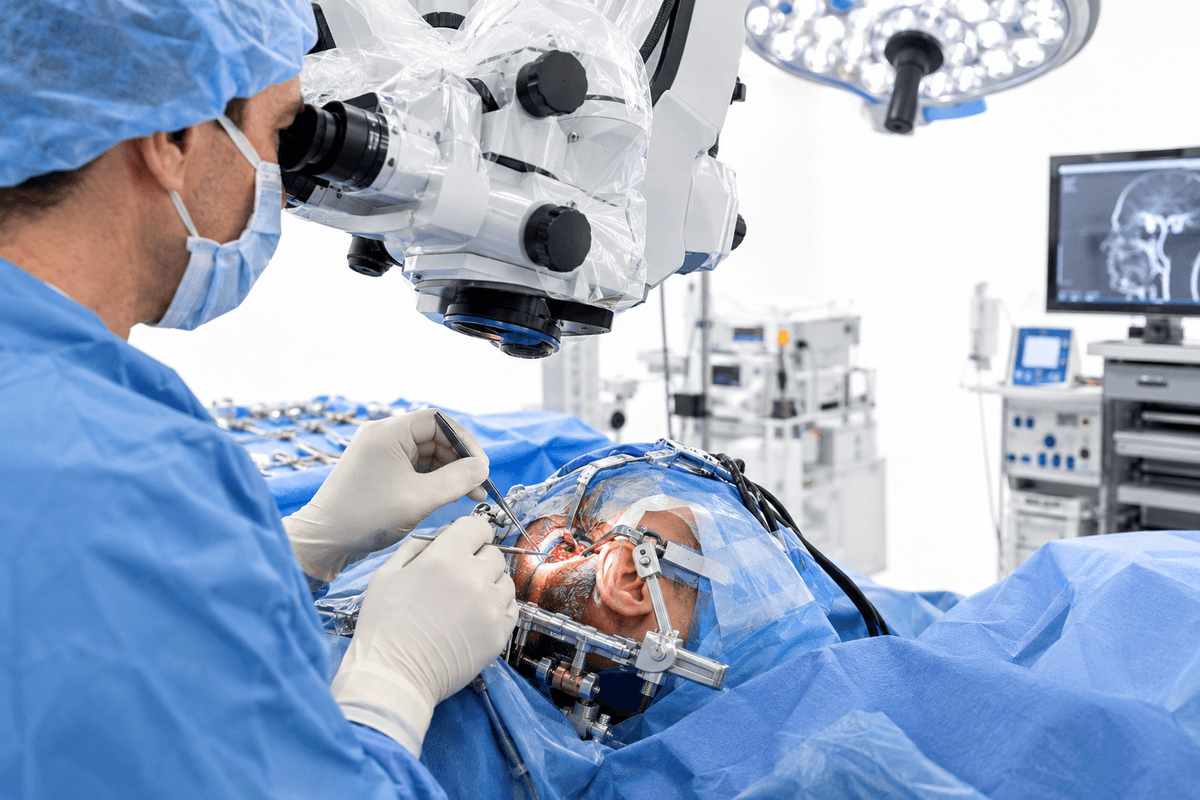
Performed by Dr. Surya Sri Krishna Gour
Open skull base surgery is a procedure to access and treat tumours, lesions, or vascular abnormalities located at the base of the skull—the area between the brain and the facial structures. The surgeon creates an opening through bone to reach deep areas that are difficult to access, working carefully around critical nerves and blood vessels.
We believe in honest, upfront disclosure so you can make an informed decision.
A step-by-step look at what happens during this procedure.
The patient is placed under general anaesthesia and positioned to allow clear access to the skull base, often with the head secured in a frame.
The surgeon makes an incision, often along the scalp or through facial structures, and carefully removes portions of bone to reach the skull base.
Using a microscope and specialised instruments, the surgeon navigates around critical structures such as nerves, arteries, and the brainstem to expose the target area.
The tumour, malformation, or abnormal tissue is removed or repaired. Care is taken to preserve surrounding healthy tissue and nerves.
The bone may be replaced or reconstructed with grafts or plates. The incision is closed in layers, and drains may be placed to prevent fluid accumulation.
A structured, patient-first approach from first consultation to full recovery.
Dr Surya Sri Krishna Gour reviews high-resolution scans to plan the safest surgical route, identifying the positions of critical nerves and blood vessels.
The procedure is performed using an operating microscope and micro-instruments to work precisely in tight spaces at the skull base.
Nerve and brain function monitoring may be used during surgery to reduce the risk of injury to vital structures.
Close observation in the intensive care unit follows surgery, with regular neurological checks and imaging to ensure stability and detect any complications early.
What to expect at each stage of your recovery journey.
Rest is essential. Headaches, swelling, and fatigue are common. Avoid lifting, bending, or straining. Follow wound care instructions carefully to prevent infection.
Gradual increase in light activities. Neurological symptoms such as numbness or weakness may improve slowly. Attend follow-up appointments for wound checks and imaging.
Return to more normal activities as advised. Some patients require rehabilitation for speech, swallowing, or movement. Full recovery timelines vary based on the extent of surgery and individual healing.
The procedure aims to remove or reduce the size of the abnormal tissue at the skull base, which may relieve pressure on the brain and nerves.
Symptoms such as vision changes, hearing loss, facial pain, or headaches may improve after surgery, though outcomes depend on the nature and extent of the original condition.
The goal is to protect critical brain and nerve function during removal. However, some patients may experience new or persistent deficits due to the complexity and location of the surgery.
Not all tumours or lesions can be fully removed, especially if they involve vital structures. Further treatment such as radiation therapy may be needed.
The right choice depends on your diagnosis, risks and circumstances — discussed with you at your consultation.
A less invasive approach using a thin camera inserted through the nose or small openings. It may be suitable for certain tumours that do not require wide bone removal, though not all lesions can be reached this way.
Focused radiation beams target the tumour without an incision. This option may be considered for small, deep lesions or for patients who cannot tolerate open surgery, though it does not provide tissue for biopsy.
For slow-growing or asymptomatic lesions, careful monitoring with MRI scans may be chosen, especially in older patients or those with significant medical risks. Treatment is started only if the lesion grows or causes symptoms.
Let's clear up some of the most common myths about open skull base surgery.
Get a personalised assessment from an experienced specialist. Understand your options, ask your questions, and decide with confidence.